The unparalleled destruction wrought by World War II - and the potential for even greater destruction via nuclear weapons developed at the end of that conflict - turned the axiom "those who fail to learn from history are doomed to repeat it" into the Baby Boom era mantra. But what's wrong with, occasionally, repeating the past, anyway?
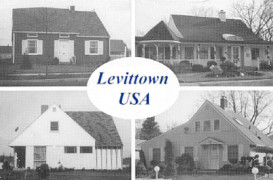
In my 51 years, I've seen places hitherto impoverished, like Singapore and Ireland, dramatically increase their standard of living, India and China acquire - albeit small - a middle class, the Russian people throw off their Soviet oppressors, and South Africa make progress that would never have been imagined just a few years earlier. I also saw my father die peacefully in his own suburban house in Levittown 70 years after he was born in the poverty of a crowded Brooklyn apartment; a blue collar worker with no high school education and six kids nevertheless, like many others of his generation and socioeconomic background, able to afford a suburban home due to the tax, labor, trade, immigration, and educational policies of the 1945-70 era and the opportunities they afforded ordinary working people. That those polices and opportunities no longer exist is evidence that we are victims of our history whilst the aforementioned success stories indicate that this need not always be the case.
We have forgotten just how much what Karl Marx called "the dead hand of the past" has a firm grasp on the present. Our children enjoy "summer vacation" simply because when our local school districts were established - Hicksville (1835), Jerusalem (1812), and Island Trees (1902) - American children needed July and August to work on the family farm. Our chaotic morass of overlapping districts and redundant jurisdictions that gave us bureaucratic gridlock and stratospheric taxes hark back to pre-War days when small communities were separated by undeveloped land and cultivated fields rather than one continuous matrix of suburban subdivisions.
We live on an island mostly off of coastal Connecticut but politically joined to land-locked New York State by virtue of the Duke of York's endeavor to isolate the Puritans of New England. The Nassau/Suffolk border approximates the 1650 Treaty of Hartford line between the Dutch West India Company and the New England Confederation. The Town of Hempstead/Oyster Bay line is from a 1648 land deed between the Quaker Robert Williams and Pugnipan of the Matinecock Indians. And so on.
As inescapable as the past is, which is why the study of history is an endless endeavor, it's important, contrariwise, to know just how fundamentally and qualitatively dissimilar present circumstances and arrangements can be. For example, the age of the family farm, blacksmith shop, and peddler's push cart really can't be compared to the age of multinational corporations, shopping malls, and big box stores. Can Poor Richard's Almanack really be compared to media conglomerates and transglobal telecommunications networks? Can the nation that received Ellis Island's huddled masses in the age of steam, coal locomotives, and telegraph be even vaguely compared to contemporary America? Can clusters of homespun farming communities, fishing villages, and plantations along the eastern seaboard with fewer people than live in Brooklyn and the Bronx today really be compared to our three hundred millions spread out over multiple time zones in a global technological society?
Is it possible that nothing in our past can prepare us to address contemporary issues; that insofar as the past is inescapable, it is also an albatross 'round our necks? I don't think so. Knowing that, as Gertrude Stein famously quipped, "the past is a foreign country", allows us sufficient contrast in which to have a frame of reference. For example, in the December 1968 issue of The Long Island Forum (where I was a contributing editor between 1997 and 2004) Alonzo Gibbs described life in the 1820's in the Bethpage/Plainview/Island Trees area thusly:
"Scattered farms occupied principally by persons related by blood, a self-sufficient agrarian economy that looked beyond its own boundaries for little more than sugar, salt, tea, and a few luxuries. There was little trade with the outside world and no industry."
That, I suspect, will describe our area in 2513 but that's not what life in early 21st Century suburbia is like. The contrast is illuminating. But as my father's aforementioned attainment of the suburban American Dream after a childhood of poverty shows, we need not go back as far as Gibbs. Levittown in the Eisenhower/Kennedy era was a middle class community and, in 2013, it is so only in the cultural sense. We are victims of our history.
Of course, being a victim of our history is not the same as being forevermore victimized by history - as Singapore, Ireland, India, China, and Russia prove otherwise. Every generation is a new chapter and every year is an opportunity to begin writing a new chapter. "The future is unknowable" Sir Winston Churchill noted, "by the past should give us hope."
Want to learn more about the history of Levittown and the surrounding communities? Visit www.levittownhistoricalsociety.org